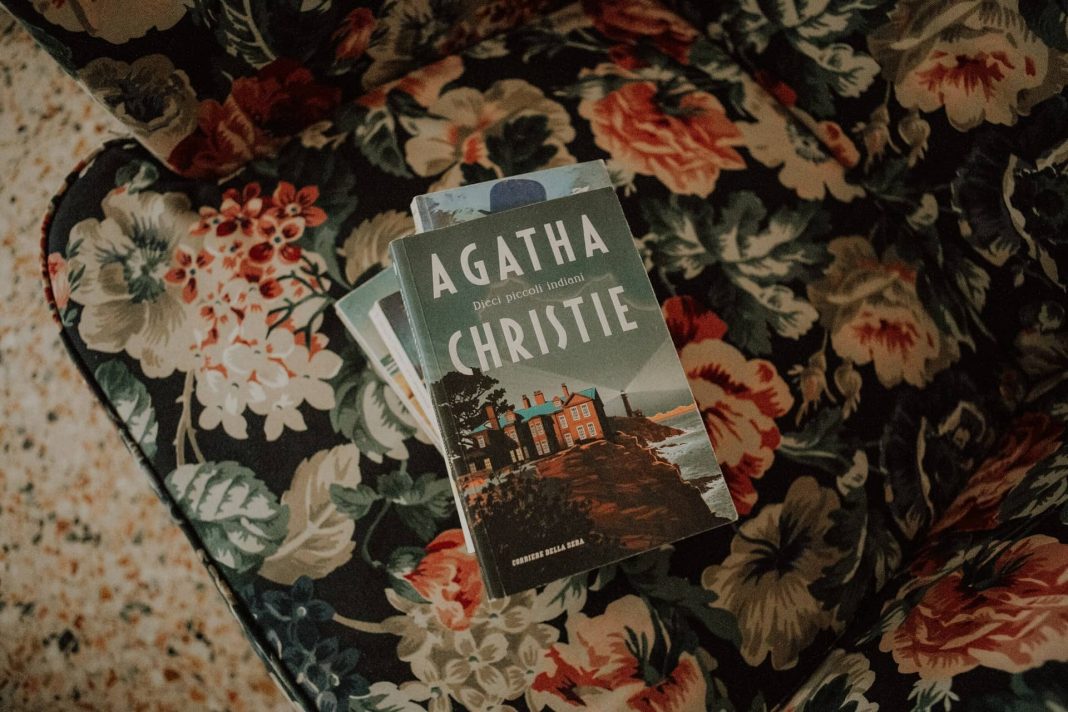
Pick up any Agatha Christie novel at random and you will find a similar setup: a body, a house full of liars, a detective who reunites everyone in a drawing room for the reveal. She built that machine and ran it for over fifty years, across sixty-six detective novels. The ten below are the ones that survive a modern reread, and they share a pattern: nearly every one of them breaks the machine she perfected. A killer no detective ever catches. A corpse timed to a newspaper advertisement. A narrator who shouldn’t be trusted. If you only ever read ten Christies, read these, counting down from ten to the one nobody has ever beaten.
10. A Murder Is Announced
A notice appears in the Chipping Cleghorn Gazette: a murder has been arranged, and will take place at Little Paddocks on Friday the 13th, at 6:15 in the evening, precisely. The neighbours, being English, treat it as an invitation and arrive in time for drinks. Someone is shot. Miss Marple, visiting nearby, quietly starts comparing the guests to people she has known all her life, and that comparison is the whole method of the book. The critics adored it: Julian MacLaren-Ross wrote in the Times Literary Supplement that Christie’s fiftieth book “establishes firmly her claim to the throne of detection,” though Robert Barnard grumbled about “an excess of homicide at the end.” The real pleasure is the setup: a village that turns up to watch a murder like it’s a village fete, then discovers it wasn’t a game.
9. Five Little Pigs
Sixteen years before the novel opens, Caroline Crale was convicted of poisoning her husband, the painter Amyas Crale, and died in prison. Her daughter, grown up and armed with a letter, hires Poirot to re-examine a case that everyone considered closed. There is no fresh evidence, no forensics, no body: only five survivors, each of whom writes an account of the fatal weekend, and five versions of the same afternoon that don’t agree. Poirot detects entirely from paper. Published in America as Murder in Retrospect, it is the book critics reach for when they argue Christie was more than a plotter. Barnard went further than most: “The-murder-in-the-past plot on its first and best appearance – accept no later substitutes,” and elsewhere, that it is “a beautifully tailored book,” going so far as to call it the best Christie of all. A rare novel where the most vivid characters have been dead for a decade before page one.
8. The A.B.C. Murders
A killer working down the alphabet sends Poirot mocking letters, one town ahead of each murder: Andover, Bexhill, Churston. It reads like a serial-killer novel written half a century early, and it plays a dirty trick on the reader: the obvious question is who the murderer is, and the actual question is why a serial killer keeps writing taunting letters to a private detective. The narration splits between Captain Hastings and a collage of witness statements, letters, and official reports, which was experimental territory for Christie in 1936. Few sentences have aged worse than the period’s casual attitudes, but the mechanics still close with a click. This is the one for readers who think Christie only does country houses.
7. The Murder at the Vicarage
The vicar narrates, which means the murder investigation is filtered through a man chiefly worried about his parish, his sherry, and his younger wife. The victim, Colonel Protheroe, was a magistrate so disliked that the vicar openly said anyone who murdered him would be doing the world a favour, and half the village had a reason to try. This is the book where Miss Marple steps out of short stories into novels: a fluffy old woman in a corner whom nobody takes seriously, including the police, and who wins by knowing that human nature repeats itself. Less ingenious than her later plots, and all the better for it. The village gossip is the point, and Christie knew it.
6. Crooked House
No Poirot, no Marple: just the Leonides family, three generations crammed into one swollen Thames-side mansion, and a patriarch whose insulin injection is swapped for poison. The investigation falls to Charles Hayward, engaged to a granddaughter of the dead man, which means every suspect is about to be family. The ending is the sort Christie refused to let be softened for her stage adaptation, and it remains one of the most discussed solutions in her whole output; go in unspoiled if you can. She had a soft spot for it herself. “Writing Crooked House was pure pleasure,” she said, “and I feel justified in my belief that it is one of my best.”
5. Curtain
Written in the 1940s and locked in a vault for three decades, Poirot’s last case was published a year before Christie’s own death, and she ordered that no other Poirot novel be published after it. He returns to Styles Court, the country guesthouse where he began in 1920, now a shabby relic, his body ruined by arthritis, his mind intact. There is a killer at Styles, one Poirot says he cannot prove guilty by any lawful means, and the book spends its pages asking what a good man does with an unprovable evil. The farewell is handled without sentiment, which somehow makes it hit harder. Read it last. Really: last. The final chapter assumes you’ve spent years with this egotistical little Belgian and will feel the loss.
4. Death on the Nile
Linnet Ridgeway has everything, including, inconveniently, a husband stolen from her best friend, and both of them on the same paddle steamer cruising the Nile with Poirot aboard. She is shot through the head on the second night, and the passenger list turns out to be a museum of grudges; one passenger had said, in Poirot’s hearing, that she’d like to put a pistol against Linnet’s head and pull the trigger. The puzzle mechanics are Christie at her most generous, scattering real clues across the boat, but the book’s centre is colder than most: it is about obsession wearing the mask of romance. The 1978 film and the 2022 remake both borrowed the title; neither captured the meanness of the original’s view of love.
3. Murder on the Orient Express
A snowdrift stops the train in Yugoslavia, a passenger lies stabbed twelve times in his locked compartment, and the murderer must still be aboard. That setup alone would carry most novels; the solution, once Poirot assembles the clues, is the one everybody now knows and nobody correctly guesses the first time. Christie is widely believed to have written it in room 411 of the Pera Palace hotel in Istanbul, which you can still book today, complete with a plaque. The plot rests on an actual 1932 kidnapping case that ended badly, and the book brazenly asks the reader to enjoy a verdict that no court would ever reach. It is a conjuring trick performed in a single carriage, and it works every time.
2. The Murder of Roger Ackroyd
The novel that nearly ended her career and made it. Roger Ackroyd is stabbed in his study an hour after learning who blackmailed his fiancée to death, and Poirot, retired next door to grow vegetable marrows, takes his last case. The solution broke the genre’s one unwritten rule so badly that Christie was accused of cheating, and Dorothy L. Sayers took her side in the row. History settled it: in 2013 the British Crime Writers’ Association voted it the best crime novel ever written, and it sits on Howard Haycraft’s list of the most influential crime novels. The trick only truly works once, and only if you don’t know it’s coming, so say nothing about the ending to anyone you like.
1. And Then There Were None
Ten strangers are invited to a bare island off the Devon coast by a host none of them has met. A gramophone accuses each of causing a death the law never touched, and then the nursery-rhyme statuette on the dining-room table begins to disappear, one doll per corpse. There is no detective. There is no one to be clever. Just ten guilty people, cut off, counting. It is frequently named the best-selling mystery novel ever written, and Jeffrey Archer has called it simply the best thing she ever did. As a technical achievement, the hardest problem in detective fiction is what happens when you remove the detective, and Christie solved it on the first attempt and never again matched the result. Start here if you’re new. Come back here if you’re not. It is the one book on this list that behaves like a nightmare, and that’s exactly why it’s first.