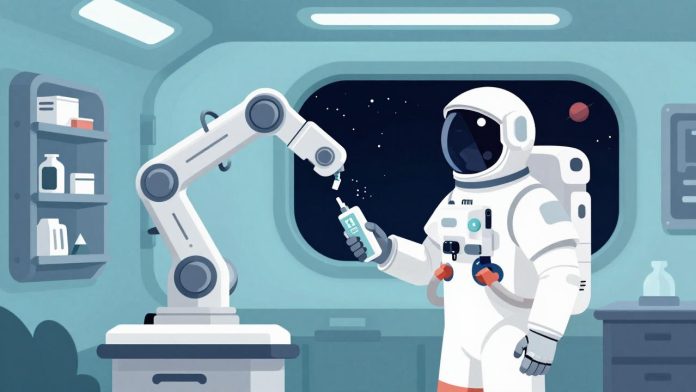
Google and NASA are working together on a robot intended to help astronauts handle medical problems and routine chores on long missions far from Earth. The project brings together Google Cloud, NASA’s Human Research Program, the robotics team at Johnson Space Center and the Jet Propulsion Laboratory. It is aimed at a problem that gets harder the further a crew travels from home.
Why distance is the real obstacle
On a future deep space mission to Mars, a message and its reply could take up to 44 minutes to make the round trip. Jim Kelly, vice president of federal sales at Google Public Sector, described that delay as one of the severe operational challenges crews would face, since real-time medical guidance from Earth would be close to impossible. A crew dealing with a sudden illness or injury cannot wait that long for advice, so more of the response has to happen on board.
An extra pair of hands, not a replacement
The robotics work builds on the Crew Medical Officer Digital Assistant, or CMO-DA, an AI clinical decision-support system that Google and NASA have been evaluating since 2025. That tool is designed to help astronauts assess health problems when distance and communication delays make immediate consultation with Earth-based doctors difficult.
Early trials of the software produced physician-rated diagnostic accuracy of 88% for ankle injuries, 74% for flank pain and 80% for ear pain, according to NASA presentations cited in reporting on the project. Google and NASA are now working with medical doctors to refine the model.
The new system is described as a proof-of-concept physical robot, designed first as a payload handler that can manage cargo, logistics and equipment. When it is not organising tools or securing compartments, it can shift to medical support.
Kelly said the aim is a robotic system that can carry out a variety of tasks on simple voice instructions, under the astronauts’ direct supervision and command. In one example Google gave, a crew member with severe back pain that might point to kidney stones could request an ultrasound. The robot would retrieve and prepare the equipment and help position it, while the crew medical officer interprets the images and decides on treatment.
What the early tests actually show
In initial laboratory demonstrations, the robot achieved an 85% baseline success rate at locating and moving a medical bag. That is a relatively basic retrieval task, and it does not establish whether the system can reliably perform medical examinations or assist with complicated emergencies.
Google said the team used DeepMind’s MuJoCo physics simulator to assess movement and object handling before attempting more demanding applications, and adapted navigation technology developed at the Jet Propulsion Laboratory to help the robot move through its surroundings and locate equipment. Nextgov/FCW reported that the system used the open-source Pi0 model from Physical Intelligence, trained on Google Cloud infrastructure.
Proof of concept, not a flight-ready system
Google has described the work as a proof of concept, with early laboratory demonstrations completed but no confirmed, fully integrated, space-ready robot. NASA declined to provide detailed information about the project, saying it is examining several advanced AI initiatives with partners for possible future missions.
Several questions remain open. Microgravity changes how a robot arm moves and how fluids behave, conditions a laboratory floor does not reproduce. An 85% success rate on a medical bag also means roughly one attempt in seven fails, which matters more when the nearest resupply flight is months away.
For now, the project sits alongside a wider set of AI efforts both organisations are evaluating for missions beyond low Earth orbit. Its practical capabilities will depend on further testing and on whether it can be integrated successfully with spacecraft operations.