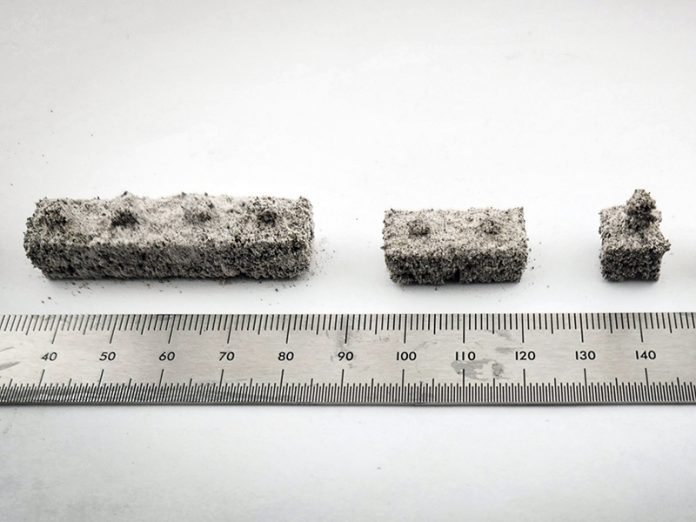
Somewhere in a lab in Fayetteville, Arkansas, a laser has been firing pinpoints of heat into fake moon dust, and what came out the other end looks suspiciously like someone ran a LEGO bin through a space-age kiln. The pieces are only a few centimeters wide. Some are cross-shaped, some look like the letter H, and they click together into bigger structures without a drop of glue.
The trick, according to a team at the University of Arkansas, is that the bricks are made of nothing but simulated lunar soil. No binders, no additives, no cargo manifest entries labeled “glue, 400 kg.” The dust binds to itself.
Why everyone wants to build with Moon dirt
Lunar regolith — the loose, gritty blanket covering the Moon — is an unfriendly building material. Unlike Earth soil, it contains no organic matter at all. It’s the residue of roughly 4.5 billion years of asteroid and micrometeorite impacts: jagged, sharp-edged particles that don’t stick together on their own.
That’s a problem when every kilogram you bring from Earth costs a small fortune in rocket fuel. So most blueprints for lunar construction call for a binder shipped from orbit, or mixing regolith with bonding agents to make a sort of space concrete. Researchers have 3D printed objects from regolith before — always with something extra stirred in.
The Arkansas team skipped the extra. Using a 3D printing method called laser powder bed fusion, they spread a razor-thin layer of regolith simulant across a bed, hit selected spots with a concentrated light source, and let sintering do the rest: the heat makes neighboring particles fuse at their contact points. The bed lowers, a new layer of powder spreads on top, and the process repeats until a solid object climbs out of the dust pile. The team reports it’s the first to sinter lunar regolith simulant directly into reconfigurable building blocks using a relatively low-power light source.
“There’s nothing else it’s binding to,” said first author Cole McCallum, an undergraduate at the time of the research. “The regolith powder is binding to itself.”
What the bricks actually are
The team’s material wasn’t real Moon dirt — it was Lunar Highlands Regolith Simulant (LHS-1), a commercially available stand-in formulated to mimic the samples the Apollo missions carried home in the 1960s and 1970s. From it, they printed interlocking blocks a few centimeters across in two complementary shapes: a cross-shaped “male” piece and an H-shaped “female” piece. Slot them together and you can assemble walls and larger structures without any mortar, adhesive, or welding.
The modular idea matters as much as the material. Printing one giant monolithic dome in one go is risky — a flaw mid-print can ruin the whole structure. Small interchangeable bricks offer three things a single pour cannot: simpler manufacturing, easy repairs (swap a damaged brick), and construction flexibility (rearrange the settlement as needs change).
Don’t order a Moon house yet
Here’s the catch, and the team is upfront about it: binderless bricks are the weakest kids on the playground. Because there’s no binding agent filling the gaps, the parts came out more porous — pocked with internal voids — and structurally weaker than objects printed with binders.
“These structures we’re making can be self-supported,” McCallum said. “But I would be hesitant to say our process could be used for something that’s supporting other loads at this moment yet.”
In other words: the bricks can hold themselves up, but don’t stack a water tank on them. And two big lunar realities remain untested. Nobody knows how the printing behaves in microgravity, where powder doesn’t settle the way it does on a lab bench, or in vacuum, where heat flows differently than it does in air. Senior author Wan Shou, an assistant professor of mechanical engineering at Arkansas, says both environments need further experiments, and the bricks’ mechanical performance needs optimization before they’re genuinely practical.
The bigger picture
Why does a batch of centimeter-scale bricks matter? Because NASA’s long-term plans — Artemis-era ambitions for a sustained human presence — hinge on exactly this kind of math. If a habitat’s shell can be built from material already under an astronaut’s boots, the launch manifest shrinks from “tons of construction materials” to “one printer plus power.” Shou is optimistic the approach could eventually offer an efficient way to manufacture components and structures for permanent settlements on the Moon.
The study, “Additive manufacturing of lunar regolith for reconfigurable building blocks toward lunar habitation,” was published August 29, 2026 in npj Advanced Manufacturing. McCallum, a Little Rock native, started in Shou’s lab early in his undergraduate studies and is now studying aerospace engineering at ISAE-SUPAERO in Toulouse, France.
Until vacuum-rated printers start stamping out real regolith bricks, the Arkansas team’s demonstration is a proof of concept. But it’s an appealing one: the idea that the Moon’s most abundant, most annoying substance — the dust that wrecks seals and coats visors — might double as the housing stock. Giant adult LEGOs, made of the ground they stand on.
Via SciTechDaily and the University of Arkansas newsroom.