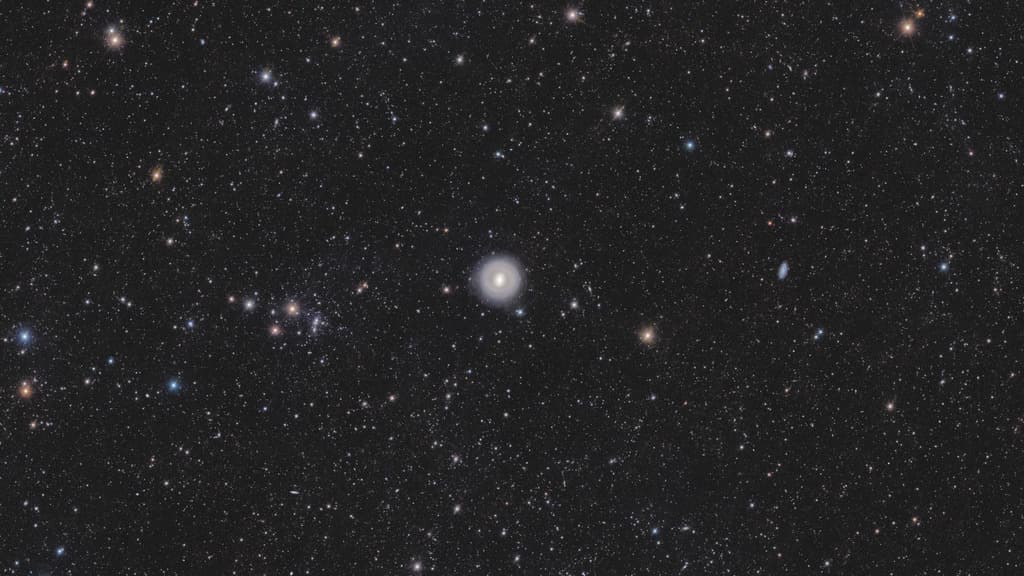
Try counting 900 million things, one per second, without sleeping. You would finish in about 28 and a half years. On 12 November 2026, the European Space Agency opened the first major tranche of data from Euclid, its dark-universe telescope, and the numbers belong to the kind of announcement astronomers reserve their bold type for: more than 900 million galaxies spread across 380,000 square degrees of sky, a projected area some 200 times that of the full Moon. It is the largest three-dimensional map of the universe anybody has ever assembled. And it is only the beginning.
Half of the story here is what hides between the galaxies. The other half is the galaxies themselves.
Roughly 95 percent of the universe consists of dark matter and dark energy, stuff that neither emits nor reflects light and has never been seen directly. Euclid was built to catch the two intruders in the act, indirectly. Dark matter bends the light passing it, warping the shapes of background galaxies by amounts too small for any single photograph to reveal. Dark energy is speeding up the expansion of space itself, thinning the cosmic web as time goes on. Chart where hundreds of millions of galaxies sit and drift across billions of light-years, and those two effects begin to show their hands.
A telescope parked 1.5 million kilometres from traffic
Euclid launched in July 2023 and now orbits the second Lagrange point, a quiet gravitational eddy 1.5 million kilometres behind Earth, where the telescope stares outward into darkness while the Sun, Earth and Moon all line up behind it. From there it photographs the sky in visible and near-infrared light, tuned for breadth rather than beauty: not one dazzling nebula, but the patient accumulation of a third of the entire sky.
The raw feed arrives at about 65 gigabytes per day, and no human team can read it fast enough. Ground software sorts the haul in monthly batches of roughly 850,000 galaxies, using machine learning to separate spirals from ellipticals and flag the oddities before any astronomer gets a look. By the time the survey wraps up around 2030, the mission is expected to have shipped some 45 petabytes of data, orders of magnitude more than the archive that produced this week’s release.
The galaxies are data too, not just backdrop
Dark matter gets the headlines, but the catalogue is a gift to astronomers who study galaxies on their own terms. An earlier Euclid release already produced a detailed visual morphology catalogue, flagging features such as bars and spiral arms, with machine-learning classifiers doing the sorting at a rate no human team could match. Scale that to hundreds of millions of objects and questions that used to be answered from samples of a few thousand galaxies suddenly gain a thousandfold: how often galaxies merge, what happens to their star formation when they collide, how quickly they burn out as they age, and how all of that shifted over cosmic time.
The positions add their own layer. Because looking farther out means looking further back in time, the 3D map doubles as a movie of cosmic history: where structures grew quickly, where growth stalled, and whether that story matches what dark energy is supposed to be doing to the expansion. The 12 November release draws on the mission’s first observational phase, meaning the deepest reaches of the survey are still ahead of it.
So what can a photograph of 95 percent nothing actually prove?
Quite a lot, provided nobody insists on seeing dark matter up close. When an invisible clump of it floats between us and a distant galaxy, the galaxy’s image warps by a fraction of a percent. One such distortion is noise. Millions of them, stacked and averaged across the catalogue, trace the invisible scaffolding the way grass bending in a field traces footsteps nobody saw.
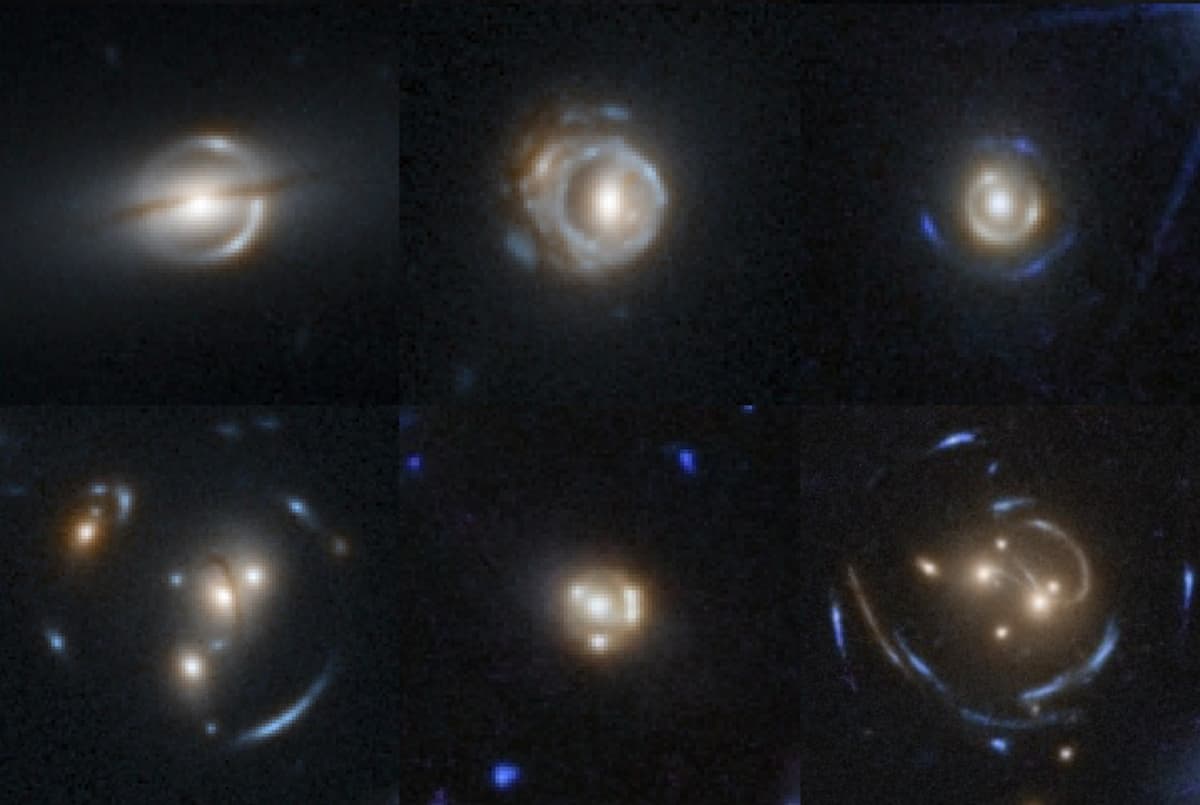
The release also delivered the largest haul of strong gravitational lenses ever assembled. From roughly 68 million candidate galaxies, machine learning flagged plausible lensing systems, thousands of citizen scientists inspected the shortlist, and experts graded the survivors. The result, described in a series of Euclid Collaboration papers posted alongside the release, is a catalogue of 15,072 confirmed strong lenses, over an order of magnitude more than any previously modelled sample. Each one is a natural telescope: a foreground galaxy whose gravity magnifies a more distant galaxy behind it, allowing researchers to weigh the foreground’s dark matter while studying the background galaxy in detail neither would allow on its own.
Small map today, verdict later
The standard model of cosmology has passed every test thrown at it so far, mostly. It rests on the assumption that dark energy is a constant push baked into empty space, and a minority of measurements have hinted that the push may instead change over time. Euclid’s full catalogue is designed to settle the question with enough precision that the answer stops depending on who ran the measurement.
Either the universe keeps obeying Einstein’s equations, or it quietly does not, and the evidence is flowing to ground stations at 65 gigabytes a day. In the meantime, 900 million galaxies now sit in a public archive waiting to be counted, sorted, and argued over. Anyone tempted to verify the tally personally should start tonight; at one per second, the job runs to 2055, by which point Euclid will have shipped considerably more.