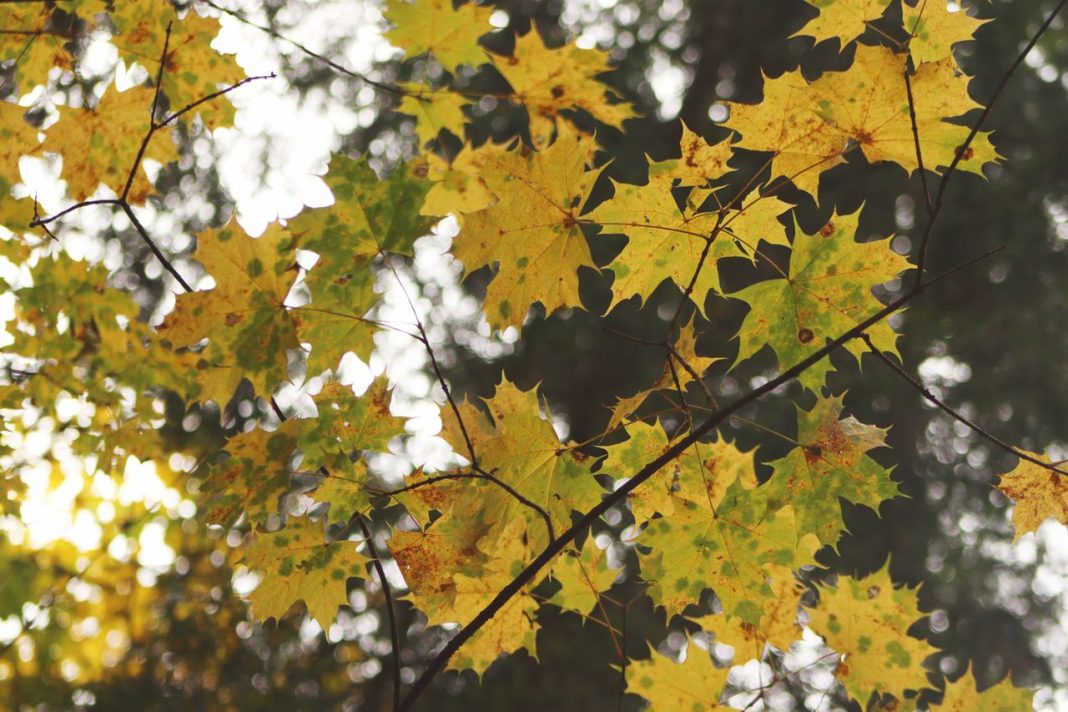
The orange and yellow of autumn are not made in autumn. Those pigments have been inside the leaf since spring, hidden behind a wall of green, and what changes in October is not what appears but what disappears.
Through the growing season, a leaf runs on chlorophyll, the compound that captures sunlight and registers to our eyes as green. It is also unstable, so the tree keeps manufacturing it all summer. As days shorten, that production winds down and the chlorophyll already in the leaf breaks apart. With the green gone, two pigments that sat underneath it the whole time become visible: xanthophylls, which read as yellow, and carotenes, which read as orange. Carotenes are the same compound that colors carrots, which is less of a coincidence than it sounds, since the pigment class was named after the vegetable.
The reds are built fresh
Reds and purples follow a different script. Unlike yellows and oranges, they come from anthocyanins, pigments the leaf manufactures only in fall. The trigger is a mismatch in the leaf’s plumbing: on sunny autumn afternoons the leaf keeps photosynthesizing and producing glucose, but as nights cool, the veins that move sap in and out of the leaf constrict. Sugar gets trapped inside, and the pooled sugars are what get turned into anthocyanins. The final shade depends on the acidity of the trapped sap, which nudges the pigment toward scarlet or toward magenta.
Why some trees only manage gold
Whether a tree can put on a red show at all is written in its genes. Species such as sugar maples, dogwoods, and sweetgums carry the machinery for those deeper reds and purples. Most deciduous trees do not, and no amount of favorable weather will push them past yellow or gold. Late September through November, depending on region, is when the shift plays out across deciduous forests.
Brown, the last color
A leaf that has spent its chlorophyll, carotenoids, and anthocyanins is at the end of its life cycle. The dull brown that closes the season comes from tannins, waste compounds left behind in the tissue. Tannins are the same chemical family that gives red wine its dry, astringent finish, which makes the tan carpet under a maple not so different from what happens in a barrel of cabernet.
So the palette of fall is really three separate chemistries stacked on one leaf: pigments revealed, pigments built, pigments left over. The greens retreat, the yellows and oranges step out from behind them, the reds arrive late and unevenly, and the browns are simply what remains when the show is over.