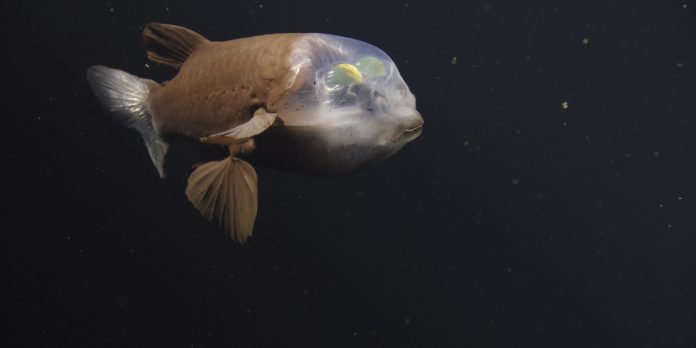
Deep-sea researchers have recorded the first 4K footage of a barreleye fish, a small species whose eyes sit inside a transparent head, roughly 600 meters beneath the surface of the Pacific.
The encounter took place on October 20 in the outer Monterey Canyon, about 90 kilometers off the coast of Central California. Despite nearly 40 years of deep-sea operations, around 7,000 remotely operated vehicle (ROV) dives and more than 41,000 hours of recorded video, the Monterey Bay Aquarium Research Institute (MBARI) has crossed paths with the species only 11 times. Its last sighting was in 2021.
A sighting nobody planned for
The day’s science was already finished. Pilots aboard MBARI’s research vessel David Packard were flying the ROV Doc Ricketts back to the surface for recovery when research specialist Shannon Johnson spotted the fish and called for them to stop. Word spread quickly, and the control room filled up: scientists who had left for the wet lab ran back, joined by members of the ship’s crew. MBARI described it as standing room only. The team spent about 20 minutes with the animal.
Eyes behind a glass shield
The barreleye, Macropinna microstoma, is built around a single task: seeing upward in near-total darkness. Its large tubular eyes, glowing green under the ROV’s lights, scan the water above for the silhouettes of prey. Once something edible drifts into view, the eyes rotate inside the transparent dome so the fish can keep the target in sight.
The dome itself is thought to protect the eyes from the stinging cells of siphonophores, the long colonial jellies whose trapped plankton MBARI researchers suspect the barreleye steals. The fish’s scientific name translates to “large fins, small mouth.” Those big fins let it hang nearly motionless in the water column while it watches the surface far above, and it feeds through a narrow, toothless mouth suited to picking small animals out of the dark.
What the 4K footage is for
MBARI did not collect the animal. The team instead filmed it from multiple angles, experimenting with different lighting conditions to document the transparent head shield. ROV pilot Cameron Law maneuvered Doc Ricketts close enough to capture 3D stereo footage with the vehicle’s VR camera, material that could support future education and outreach work. This was also the first barreleye sighting filmed from the David Packard, MBARI’s new flagship research vessel.
The close-ups will feed the institute’s long-running research into how animals see in the twilight zone, the dim ocean layer where the barreleye spends its life. MBARI’s Biodiversity and Biooptics Team has spent years reconstructing vision at depth, often from animals hauled up damaged in nets. Footage of a live, undisturbed specimen is the harder evidence to get, which is why an accidental sighting on the way up mattered more than anything the team had planned that day.
The fish was left where it was found. What came back to shore was roughly 20 minutes of 4K video and, for everyone crowded into that control room, the clearest look at the species anyone has had.